

The Ultimate Guide on How to become an Investment Analyst in the UK
An investment analyst researches and evaluates financial securities, companies, and markets to produce recommendations that guide investment decisions. In the UK, analysts are employed across asset management firms, investment banks, hedge funds, pension funds, and independent research houses. The role is fundamentally analytical — forming well-reasoned views on value and communicating them clearly through written research and verbal presentation.
The path into the profession follows a recognised progression. Understanding that progression, and preparing for each stage properly, is what separates candidates who break in from those who do not.
Education
A university degree is the standard entry requirement. UK employers in investment management and investment banking expect a minimum 2:1. The subject matters less than many candidates assume — finance and economics are common, but mathematics, engineering, physics, and other numerate disciplines are equally well regarded and in some cases preferred, particularly for quantitative research roles. What the degree signals is the ability to think rigorously and work with complex information.
Candidates from non-numerate backgrounds face a steeper climb but it is not insurmountable. Relevant professional qualifications, demonstrable self-study, and practical experience can compensate, particularly when targeting smaller firms and boutique houses.
Professional Qualifications
The Investment Management Certificate is the recognised entry-level qualification for the UK investment industry. Administered by the CFA Society UK, it covers the investment environment and portfolio management principles. The majority of UK asset managers require it either before hiring or within the first twelve months of employment. It typically takes three to six months to prepare for and costs between £500 and £800 in examination fees.
The CFA designation is the most respected qualification in the profession globally and carries particular weight in UK buy-side roles. It consists of three examination levels and takes most candidates between two and four years to complete while working. Pass rates are demanding — approximately forty percent at Level I. Employers across the UK asset management sector actively support candidates pursuing it and many offer financial sponsorship and study leave. For anyone serious about a long-term career as an analyst or portfolio manager, the CFA is not optional in practice, even where it is not formally required.
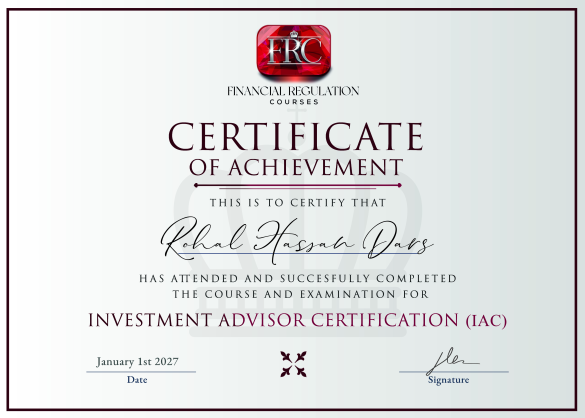
The Investment Advisor Certificate provides a practical complement to the CFA pathway, particularly for analysts who work across international markets or in client-facing roles. Where the CFA develops depth in portfolio theory, valuation, and ethics, the Investment Advisor Certificate addresses something the CFA does not — jurisdictional regulatory knowledge and client advisory practice across multiple global markets.
The core certification is extended by fourteen jurisdictional units, each covering the regulatory environment, compliance requirements, and advisory standards of a specific country or region. The available jurisdictions are the UK, USA, UAE, Qatar, Saudi Arabia, Singapore, Hong Kong, Switzerland, Germany, India, Pakistan, Canada, Australia, and Europe. Students are not restricted to a single extension — the structure allows analysts to add whichever jurisdictions are relevant to their practice, whether that is one or several.
For a UK-based investment analyst, this is particularly relevant. The industry here is international by nature. Analysts regularly cover companies listed across multiple markets, work within firms that operate globally, and increasingly serve institutional and private clients across different regulatory environments. The ability to understand how advisory obligations, disclosure requirements, and regulatory frameworks differ between jurisdictions — and to operate competently within them — is a meaningful professional advantage.
The Investment Advisor Certificate has seen strong take-up among financial analysts globally. Its value is in being cohesive with CFA Level I specifically — it sits alongside that study rather than competing with it, filling the client-facing and regulatory gap that the CFA curriculum does not address. For analysts who want to function internationally and advise clients across borders, the combination of the two credentials provides a more complete professional foundation than either does alone.
For investment analysts with a focus on sustainable finance and ESG integration, the ESG Advisor Certificate provides a dedicated qualification that sits alongside both the CFA and the Investment Advisor Certificate. As ESG considerations become embedded in investment analysis across asset classes — influencing valuation, risk assessment, and portfolio construction — analysts who can demonstrate structured knowledge in this area hold a genuine advantage in the UK market and internationally.
The ESG Advisor Certificate is available with the same fourteen jurisdictional extensions as the Investment Advisor Certificate, covering the UK, USA, UAE, Qatar, Saudi Arabia, Singapore, Hong Kong, Switzerland, Germany, India, Pakistan, Canada, Australia, and Europe. This allows analysts to develop ESG expertise that is grounded in the specific regulatory frameworks, disclosure requirements, and market standards of the jurisdictions they operate in — rather than a generic understanding that does not translate to practice. Both certificates can be taken together, making them a coherent combination for analysts building an internationally focused and sustainability-literate professional profile.
The CISI offers qualifications that are well regarded across UK broking, wealth management, and private banking. The Investment Advice Diploma and Capital Markets Programme are the most relevant for those targeting those specific parts of the market.
For career changers entering without a finance background, the Investment Advisor Certificate provides a structured and accessible foundation. It carries no entry prerequisites, takes twelve to sixteen weeks, and equips candidates with enough working knowledge to pursue the IMC and begin applying for junior roles.
Certain roles that involve advising clients require FCA authorisation under the Senior Managers and Certification Regime. In practice this is managed through the employer rather than being something candidates need to arrange independently before joining.
Skills
Financial modelling is the technical foundation of the role. Candidates are expected to be competent in Excel and capable of building discounted cash flow models, running comparable company analysis, and interpreting the outputs of leveraged buyout models at a basic level. The ability to read a set of accounts — understanding the relationships between the income statement, balance sheet, and cash flow statement — is assumed from day one.
Beyond modelling, analysts are expected to form independent views. This means being able to identify what matters in a business, assess competitive position, evaluate management, and arrive at a considered opinion on valuation. The ability to do this and then defend it clearly under questioning is what the job ultimately requires.
Bloomberg and other market data platforms are used daily. Familiarity with these tools is an advantage at the application stage, though most firms provide formal training.
Written communication is undervalued by many candidates. Investment research notes, whether internal or published, need to be precise, structured, and free of unnecessary language. Developing the habit of writing clearly and concisely about financial ideas is one of the most useful things a candidate can do before entering the industry.
Experience
Graduate schemes and summer internships are the primary structured entry routes into the larger UK firms. Schroders, Baillie Gifford, M&G, Fidelity, Artemis, abrdn, and Legal and General Investment Management all run programmes. These are competitive and recruit well in advance — applications for summer internships typically open in the autumn of the preceding year.
Candidates who do not secure a position at a larger firm should target smaller asset managers, independent stockbrokers, and research boutiques. These roles are less visible but often provide more substantive early experience and a faster path to responsibility.
Before applying anywhere, candidates should have done the work independently. Writing two or three full stock pitches on UK-listed companies, maintaining a mock portfolio with documented investment rationale, and following markets closely through sources such as the Financial Times and company regulatory announcements demonstrates genuine commitment in a way that a CV alone cannot.
The Employer Landscape
London is the centre of the UK investment industry. Edinburgh has a significant and long-established asset management community. Manchester and Leeds have smaller but growing presences.
The buy-side in the UK includes global asset managers with large UK operations — BlackRock, Fidelity, and Invesco — alongside prominent domestic firms including Baillie Gifford, Schroders, M&G, Artemis, Liontrust, and abrdn. Pension funds and insurance companies including Aviva Investors, Standard Life, and Nest manage substantial assets in-house and employ analysts directly.
The sell-side research function sits within the major investment banks — Goldman Sachs, Morgan Stanley, Barclays, HSBC, and Jefferies among them — as well as within mid-market brokers such as Peel Hunt, Numis, and Berenberg, which cover UK-listed companies extensively.
Hedge funds including Man Group, Winton, Marshall Wace, and Brevan Howard are based in London and represent some of the highest-paying opportunities in the industry. They recruit selectively and almost always require prior buy-side or sell-side experience at the analyst level.
The Interview Process
Applications are assessed through numerical and verbal reasoning tests at the initial stage. These are followed by competency-based interviews covering motivation, analytical thinking, and commercial awareness. Technical interviews assess financial knowledge — candidates should expect questions on valuation methodology, accounting, and current market conditions. Final stages typically involve an assessment centre with case studies, group exercises, and a panel interview with senior professionals.
The stock pitch is a fixture of the investment analyst interview process. Candidates are asked to present an investment idea — a company they would buy or short — and defend it under questioning. A strong pitch is structured around four elements: a clear description of the business, the investment thesis and the catalyst that makes it relevant now, a valuation argument explaining why the market has mispriced the security, and an honest assessment of the risks alongside the reasoning for accepting them. Candidates should have at least one long and one short idea prepared and be able to present either fluently in under five minutes.
Salaries
Graduate and junior analysts entering the UK market typically earn between £35,000 and £55,000. At the two to four year mark, salaries move into the £55,000 to £85,000 range. Senior analysts earn between £85,000 and £130,000. Those moving into lead analyst or portfolio management positions earn above £130,000, and compensation at senior levels within hedge funds and larger asset managers can be considerably higher when bonuses are included.
Bonuses vary significantly by firm type. In asset management they tend to range from twenty to fifty percent of base salary. In investment banking and hedge funds the variable component can exceed base salary at mid to senior levels.
Career Progression
The standard progression runs from graduate or junior analyst through to analyst, senior analyst, and then either portfolio manager or head of research, depending on the firm structure. The timeline varies but most analysts reach a senior level within five to eight years of entering the industry.
The CFA designation is the most significant qualification milestone along this path and completion of all three levels is expected for those progressing to senior positions at reputable firms. Sector specialisation — developing deep expertise in a defined area such as healthcare, technology, financial services, or energy — is what typically differentiates senior analysts and makes them genuinely valuable to their employers. Building a professional network through the CFA Society UK and industry events is worth doing consistently throughout a career, not only at the point of job searching.