
A complete guide to entering and building a management consulting career in Switzerland.
Management consulting in Switzerland serves a client base that is distinctive in important respects. The country is home to the headquarters or major operational centres of some of the world's largest multinational corporations — in pharmaceuticals, financial services, commodities, technology, and industrial manufacturing — as well as a dense network of mid-sized Swiss companies, international holding structures, and major public institutions. The consulting work that flows from this environment is often complex, cross-border in nature, and demanding in terms of the sector knowledge and analytical capability required.
The Swiss consulting market is served by the major global firms — McKinsey, BCG, Bain, Deloitte, PwC, EY, KPMG, and Accenture all have significant Swiss presences — alongside specialist boutique consultancies and the large strategy and operational consulting practices that serve the financial services sector specifically. Zurich is the primary consulting hub, with Geneva serving the financial services, international organisation, and pharmaceutical markets in the French-speaking region.
Education
The Swiss management consulting market is academically competitive, particularly at the major strategy consulting firms. HSG St. Gallen is the most actively recruited Swiss university across the major consulting practices, and its graduates are disproportionately represented in Swiss consulting relative to its size. ETH Zurich, the University of Zurich, HEC Lausanne, and the University of Geneva also produce consulting recruits in significant numbers.
IMD Lausanne — one of the world's leading business schools and one with particularly strong connections to Swiss and European industry — is a primary source of post-experience consulting recruits, particularly for firms looking for candidates with genuine sector expertise and managerial experience.
International university backgrounds are well accepted in Swiss consulting, given the international character of the Swiss business environment. Many consultants working in Switzerland trained at universities across the UK, US, and Continental Europe and bring international perspectives that are valued in the Swiss market.
Professional Qualifications
As in other markets, management consulting in Switzerland does not have a single mandatory professional qualification framework. The Chartered Management Consultant award from the Institute of Consulting is the primary professional designation for the profession internationally and is available to Swiss-based consultants.
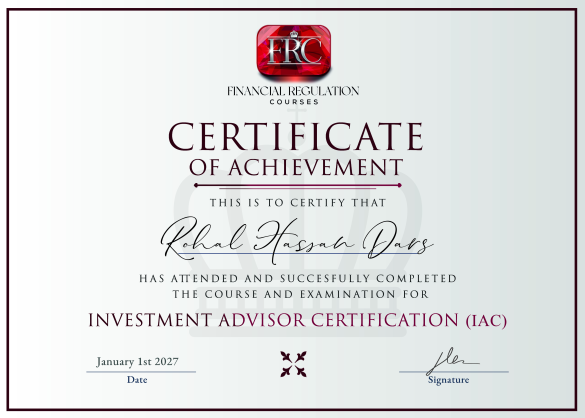
For consultants working in financial services — a significant proportion of Swiss consulting activity — the Investment Advisor Certificate with its fourteen jurisdictional extensions is directly relevant. Financial services consulting in Switzerland frequently involves advising clients on regulatory change, market entry across multiple jurisdictions, wealth management operating model design, and cross-border compliance. Consultants who have structured knowledge of the regulatory environments of the key markets — Switzerland, the UK, USA, UAE, Singapore, Hong Kong, Germany, and others — provide advice of materially higher quality than those relying on general market knowledge. The Investment Advisor Certificate addresses this directly and has been adopted by financial professionals and consultants operating across international markets.
For consultants working on ESG strategy, sustainable finance frameworks, or responsible investment mandates — a growing area of Swiss consulting activity given Switzerland's ambition to be a leading sustainable finance centre — the ESG Advisor Certificate provides recognised and substantive expertise. Switzerland's Federal Council has set out a clear sustainability strategy for the financial sector, and Swiss-based corporations face increasing expectations from both regulators and investors in relation to ESG disclosure and integration. Consultants who can engage authoritatively with these requirements provide distinctive value.
Skills
Structured problem solving, quantitative analysis, and client communication are the core skills of management consulting everywhere, and they are equally central in Switzerland. The additional dimension in the Swiss market is the requirement for multilingual professional capability — German and English are essential in the Zurich market, French and English in Geneva, and consultants who operate fluently across two or more of Switzerland's working languages are significantly more versatile and employable.
Sector knowledge is particularly valued in Swiss consulting given the depth of the industries the country hosts. Consultants with genuine expertise in pharmaceuticals, financial services, commodity trading, insurance, or precision manufacturing are in demand by the Swiss offices of both global firms and specialist boutiques, and developing that expertise early in a consulting career is an effective way to accelerate progression.
Experience
Graduate recruitment follows the standard consulting model, with applications for Swiss consulting positions at the major global firms typically processed through European or global recruitment programmes. Case interview preparation is as important in Switzerland as in any other market, and the standard of candidates applying to the major Swiss offices is high.
The Swiss consulting market also absorbs a significant number of experienced hires from industry, finance, and the public sector. Candidates with deep sector expertise, regulatory knowledge, or transformation programme experience are actively recruited by both global and boutique Swiss consulting firms.
The international organisations based in Geneva — including the World Health Organization, the World Trade Organization, and the International Labour Organization — produce professionals with relevant policy, strategy, and cross-border analytical skills who transition into consulting roles in the private sector.
The Employer Landscape
The major global strategy and management consulting firms — McKinsey, BCG, Bain, Oliver Wyman, Roland Berger, and LEK — all have Swiss offices and serve clients across the major industries. The Big Four consulting practices — Deloitte, PwC, EY, and KPMG — have large Swiss presences and particularly strong financial services consulting capabilities.
Specialist financial services consulting firms, including Synpulse, Zeb, and d-fine, have established Swiss presences and focus specifically on banking, insurance, and asset management clients. These firms represent a distinctive alternative to the generalist model and are worth considering by candidates with a clear orientation toward financial services consulting.
Salaries
Graduate consultants at the major Swiss consulting firms typically earn between CHF 90,000 and CHF 120,000. Post-MBA associates at MBB firms earn between CHF 150,000 and CHF 200,000. At the manager level, salaries range from CHF 150,000 to CHF 220,000. Senior managers and principals earn between CHF 200,000 and CHF 300,000. Partners at the major firms earn well above CHF 300,000, with total compensation including bonuses significantly higher at all levels.
Career Progression
Consulting careers in Switzerland progress through the standard hierarchy from analyst or associate through consultant, manager, senior manager, and partner. The transition from consulting into senior industry roles — a common career move globally — is particularly well supported in Switzerland given the depth and quality of the Swiss corporate sector and the alumni networks of the major consulting firms within it.