

A complete guide to building a financial advice career in the Swiss market.
Financial advising in Switzerland is shaped by a regulatory environment that has been substantially reformed over the past five years. The Financial Services Act — FinSA — and the Financial Institutions Act — FinIA — which entered into force on 1 January 2020, established a comprehensive new framework for the provision of financial services to clients in Switzerland, introducing requirements for suitability and appropriateness assessment, client segmentation, transparency in costs and conflicts of interest, and registration of client advisers in a supervisory register. For anyone entering the financial advice profession in Switzerland today, this regulatory framework is the essential foundation of professional practice.
Switzerland's financial advice market is shaped by the extraordinary concentration of private wealth in the country and among its resident population of internationally mobile professionals, expatriates, and high-net-worth individuals. Financial advisers in Switzerland operate across private banking, independent wealth management, insurance-based advice, and fee-based independent advice, advising clients whose financial affairs frequently span multiple countries, currencies, tax regimes, and regulatory environments simultaneously.
Education
A university degree is common among financial advisers in Switzerland but is not a regulatory requirement under FinSA. The Swiss vocational education system provides a respected alternative pathway — the banking Berufslehre apprenticeship, offered by the Swiss Bankers Association, is a widely used entry route for those who do not attend university and provides a thorough grounding in financial services, banking operations, and client service.
For those entering through the academic route, business administration, finance, economics, and law are the most relevant degree subjects. HSG St. Gallen, HEC Lausanne, the University of Zurich, and the University of Geneva all produce graduates who are actively recruited by Swiss financial services employers. Career changers from law, accountancy, or other professional services backgrounds are well represented in the profession and frequently bring transferable client relationship and analytical skills that are directly applicable.
Professional Qualifications
FinSA requires client advisers — defined broadly to include individuals who provide personal recommendations on financial instruments to retail clients — to be registered in the Adviser Register maintained by a recognised registration body, unless they are employed by a prudentially supervised institution such as a FINMA-licensed bank or securities firm. The registration requirements include proof of adequate knowledge of the rules of conduct under FinSA and the necessary expertise in the financial services offered.
The CFP — Certified Financial Planner — designation, awarded in Switzerland by the Financial Planning Standards Board in cooperation with the Swiss Financial Planning Association, is the most internationally recognised financial planning and advisory qualification available in Switzerland. It is gaining consistent ground in the Swiss market, particularly among advisers who serve internationally mobile and high-net-worth clients who value internationally standardised professional credentials.
The Swiss Federal Diploma in Financial Planning — Eidgenössisches Diplom als Finanzplaner — is the most rigorous domestic qualification for financial planners and advisers in Switzerland. It is state-accredited, covers financial planning, investment, pension planning, tax, insurance, and estate planning under Swiss law comprehensively, and is the qualification most directly aligned with the requirements of the Swiss regulatory and client environment.
The Swiss Bankers Association — SBA — offers a range of qualifications through its education framework, including the Swiss Certified Bank Employee and the Certified Wealth Management Adviser designations, which are relevant for advisers working within the Swiss banking sector.
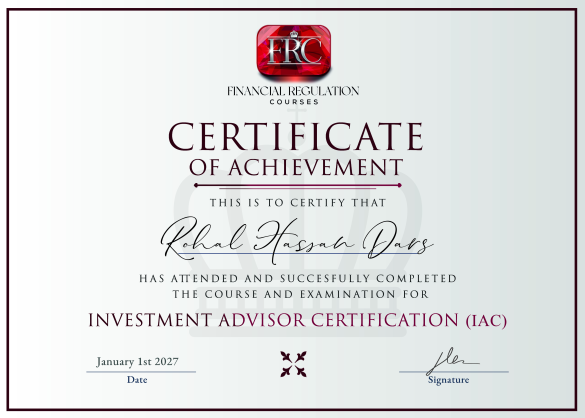
For financial advisers in Switzerland whose clients hold assets across multiple jurisdictions — which encompasses a very substantial proportion of the Swiss advisory market — the Investment Advisor Certificate provides structured and practical regulatory knowledge of fourteen key global jurisdictions including Switzerland, the UK, USA, UAE, Qatar, Saudi Arabia, Singapore, Hong Kong, Germany, India, Pakistan, Canada, Australia, and Europe.
The regulatory complexity faced by Swiss advisers working with international clients is genuine and material — different markets have different product approval standards, different disclosure requirements, different tax treatment of investment income, and different restrictions on what advice can be provided cross-border.
The Investment Advisor Certificate addresses this complexity directly and has been adopted widely by financial professionals managing international client relationships. It sits alongside existing advisory qualifications rather than replacing them and has seen strong take-up among professionals operating across borders.
For advisers whose clients are interested in sustainable investment — which in Switzerland is a substantial and growing segment of the advisory market — the ESG Advisor Certificate provides formal and recognised expertise in ESG integration and its application to client portfolios.
Switzerland's Federal Council has mandated that Swiss financial institutions assess and disclose ESG risks in their operations and products, and client-facing advisers who can engage substantively with sustainable investment considerations are better placed to serve the market's direction of travel.
Skills
Technical knowledge of the Swiss financial planning environment is fundamental. This begins with a thorough understanding of Switzerland's three-pillar pension system — the AHV first pillar, the BVG occupational pension second pillar, and the private pension savings of pillars 3a and 3b — which is the framework around which retirement planning in Switzerland is organised. The interaction between these pillars, their tax treatment, and their coordination with pension arrangements in other countries for expatriate clients is a specialist competence with significant demand.
Swiss taxation is complex and layered — federal, cantonal, and communal taxes apply simultaneously, and tax rates and rules vary significantly between cantons. Financial advisers who develop genuine Swiss tax planning expertise, including knowledge of wealth tax, inheritance tax at cantonal level, and the tax treatment of pension assets, investment income, and real estate, are substantially more valuable to clients than those with only general knowledge.
Cross-border financial planning is perhaps the most distinctive specialism in the Swiss advisory market. Advising clients who are moving to Switzerland, leaving Switzerland, or holding assets simultaneously in multiple countries requires a depth of cross-border knowledge that goes well beyond standard Swiss advisory competence.
Swiss-based advisers regularly encounter clients with UK pension rights, US retirement accounts, Middle Eastern property interests, and pan-European investment portfolios alongside their Swiss assets, and providing genuinely competent advice across these dimensions requires structured preparation.
Multilingual communication is a practical necessity for advisers operating in Switzerland. German, French, and English are all used as working languages depending on the region and client base, and advisers who can conduct the advisory relationship in a client's preferred language provide a materially better client experience.
Experience
The Swiss banking Berufslehre — the apprenticeship programme administered by the Swiss Bankers Association — is the most common entry route for those without a university degree and provides a structured two to three year programme that combines classroom study with practical banking experience. Many financial advisers in Switzerland begin their careers through this route before progressing to professional qualifications and client advisory responsibilities.
Private banks — including Julius Baer, Pictet, Lombard Odier, UBS, and the Geneva private banks — employ relationship managers and client advisers who work with high-net-worth and ultra-high-net-worth clients.
Entry at these institutions typically requires relevant professional qualifications, language skills, and in many cases prior experience in financial services.
The client advisory roles at Swiss private banks are among the most prestigious and best-compensated in the European financial advice market.
Independent financial advisers — gérants de fortune in French-speaking Switzerland — operate as standalone practitioners or within small independent firms, managing client assets and providing comprehensive financial advice on a fee or management fee basis. Following the FinSA reforms, independent asset managers are required to affiliate with a supervisory organisation and must meet defined professional and operational standards.
This segment of the market has seen significant consolidation and professionalisation in recent years and represents a genuine career destination for experienced advisers who want to build an independent practice.
Insurance-based financial advisers at firms including Zurich Insurance, Swiss Life, AXA Switzerland, and Baloise provide financial planning and protection advice within the insurance product framework and represent a significant entry-level employment market for new advisers.
The Employer Landscape
Private banks represent the most prestigious segment of the Swiss financial advisory market. UBS Wealth Management, Julius Baer, Pictet, Lombard Odier, Vontobel, EFG International, Union Bancaire Privée, and the Geneva private banks collectively manage a very substantial proportion of Swiss-administered private wealth and employ client advisers and relationship managers at every level of seniority.
Independent asset managers and gérants de fortune — particularly numerous in Geneva — provide financial advice and portfolio management to private clients independently of the major banks. This sector has been formalised and consolidated by the FinSA and FinIA reforms and represents a growing and increasingly professionalised employment market.
Cantonal banks — Zürcher Kantonalbank, Banque Cantonale Vaudoise, and others — serve the domestic Swiss retail and private client market and employ financial advisers in client-facing roles across their branch networks.
Insurance companies — Zurich Insurance, Swiss Life, AXA Switzerland, and Baloise — employ large numbers of financial advisers and represent significant entry-level and mid-career employment opportunities across German-speaking and French-speaking Switzerland.
Salaries
Junior financial advisers and client associates at Swiss private banks and advisory firms typically earn between CHF 75,000 and CHF 100,000. Established advisers with a developed client base earn between CHF 110,000 and CHF 180,000. Senior advisers and relationship managers at private banks managing substantial client assets earn between CHF 180,000 and CHF 350,000 or above, including relationship bonuses tied to assets under management. Independent advisers who have built substantial recurring fee income can earn at comparable levels to senior private bank relationship managers.
Switzerland's favourable tax environment means that take-home pay is materially higher than in the UK or Germany at equivalent gross salary levels.
Career Progression
Financial advice careers in Switzerland progress from junior adviser or client associate through to qualified adviser, senior adviser, and then towards senior relationship management, team leadership, or independent practice ownership. The most significant long-term determinant of earnings is the quality and size of the client relationships managed — the adviser who builds deep, long-term relationships with clients whose financial complexity and asset levels grow over time builds a professional practice of enduring value.
Achieving CFP certification and the Swiss Federal Diploma in Financial Planning are the most important qualification milestones. Developing specialisation in cross-border planning, Swiss pension optimisation, or the high-net-worth and ultra-high-net-worth client segment — and building a professional reputation through consistent, high-quality advice over time — are what drive long-term career and income growth in the Swiss financial advice market.