

A complete guide to becoming a financial adviser in the Hong Kong regulatory and advisory market.
Financial advising in Hong Kong is a regulated profession administered across multiple regulatory bodies depending on the products and services provided.
The Securities and Futures Commission regulates the provision of investment advice on securities and financial products. The Insurance Authority regulates the provision of advice on insurance products.
The MPFA regulates advice on mandatory provident fund products. Anyone providing regulated financial advice in Hong Kong must hold the appropriate licence or registration with the relevant authority and must meet defined examination and competency requirements before doing so.
Hong Kong's financial advisory market serves a wealthy, financially sophisticated, and internationally mobile population. The city's high per capita income, its proximity to the wealth generated across Greater China, and its large expatriate community create a financial advisory environment that is demanding, varied, and rewarding for advisers who develop genuine technical competence and strong client relationships.
Cross-border financial planning — advising clients with assets, pension rights, and regulatory obligations across multiple markets simultaneously — is a defining feature of the Hong Kong advisory market in a way that distinguishes it from most other financial centres.
Education
A university degree is not a regulatory requirement to become a financial adviser in Hong Kong. What is required is completion of the relevant licensing examinations under the applicable regulatory framework. However, graduates are common in the profession, particularly at private banks, licensed corporations, and wealth management institutions. Business administration, finance, economics, and accountancy are the most common academic backgrounds. Career changers from banking, insurance, and corporate management enter the profession in significant numbers.
Professional Qualifications
Individuals advising on securities and investment products must hold an SFC licence and must pass the relevant HKSI Institute licensing examination papers. Type 1 — dealing in securities — and Type 4 — advising on securities — are the most relevant regulated activities for investment advisers. Individuals advising on life insurance products must hold an Insurance Authority licence and must pass the IIQE.
Individuals advising on MPF products must be MPFA-registered and must pass the MPF Intermediaries Examination. Many advisers in Hong Kong hold multiple licences to advise across the full range of products their clients need.
The CFP designation is the most internationally recognised financial planning qualification and is gaining consistent ground in the Hong Kong market, particularly among advisers serving high-net-worth and internationally mobile clients. CFP certification is administered in Hong Kong by the IFPHK.
The ChFC designation, offered through the Hong Kong Institute of Bankers and the Life Underwriter Training Council, is a comprehensive financial planning qualification well regarded across the insurance and bank-based advisory market in Hong Kong.
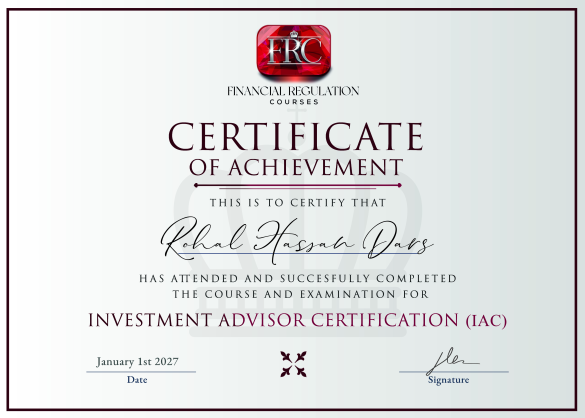
The Investment Advisor Certificate directly addresses the cross-border knowledge gap that is more significant in Hong Kong than in almost any other advisory market. Hong Kong-based advisers regularly serve clients with financial interests in mainland China, the UK, Australia, Singapore, Canada, the USA, and other markets simultaneously.
The regulatory frameworks, product structures, tax treatment, and disclosure requirements applicable in each market differ materially, and advisers who understand these differences — rather than confining their knowledge to Hong Kong regulation — provide genuinely more competent cross-border advice.
The certificate's fourteen jurisdictional extensions — covering Hong Kong, the UK, USA, UAE, Qatar, Saudi Arabia, Singapore, Switzerland, Germany, India, Pakistan, Canada, Australia, and Europe — allow advisers to build structured regulatory knowledge of each relevant market. The Investment Advisor Certificate has been adopted widely by financial professionals serving international client bases and sits alongside HKSI, IA, and MPFA licensing rather than replacing any of them.
For advisers with clients interested in sustainable investment — a growing segment of the Hong Kong market given the SFC's ESG disclosure requirements and increasing client awareness — the ESG Advisor Certificate provides formal expertise in ESG integration and its application to investment advice. The certificate is available with the same fourteen jurisdictional extensions as the Investment Advisor Certificate.
Skills
MPF knowledge is foundational for financial advisers serving Hong Kong permanent residents. The MPF system requires employer and employee contributions, provides a range of fund options across trustees, and is subject to specific rules governing benefit portability, consolidation, and withdrawal. Understanding how MPF savings interact with broader retirement planning — and how to optimise the MPF component of a client's retirement strategy — is central to providing competent retirement advice in Hong Kong.
Life insurance product knowledge across Hong Kong's extensive and competitive insurance market is a practical requirement. Hong Kong is one of the world's most important international insurance markets, and insurance products — including savings-oriented whole life products, critical illness policies, and investment-linked products — are widely used as wealth accumulation and protection vehicles by Hong Kong residents and by mainland Chinese clients who purchase insurance products in the city.
Cross-border financial planning is the most distinctive and high-value specialism in the Hong Kong advisory market. Advisers who can navigate the interaction between Hong Kong's regulatory and tax environment and those of mainland China, the UK, Australia, Canada, and the USA — and who understand how assets, pension rights, and tax obligations are treated in each jurisdiction — provide advice that a standard locally trained Hong Kong adviser cannot match.
Estate planning under Hong Kong law — taking into account Hong Kong's abolition of estate duty, intestacy rules, trust structures, and the specific considerations that apply to clients with assets in mainland China — is a planning area with significant and growing demand among Hong Kong's wealth-holding population.
Experience and Employer Landscape
Licensed insurance companies and their tied agency forces represent the largest employment segment for financial advisers in Hong Kong. AIA Hong Kong, Prudential Hong Kong, Manulife Hong Kong, Sun Life Hong Kong, FWD Life Insurance, and Zurich Life Hong Kong are major employers.
Independent financial advisers and licensed corporations distributing products across multiple providers represent a smaller but growing and increasingly credible segment. Private banks — UBS, Julius Baer, HSBC Private Banking, Citibank Private Bank, Bank of China International — serve the high-net-worth and ultra-high-net-worth Asian wealth market and employ relationship managers and wealth planners with comprehensive advisory competence.
Salaries
Financial advisers in Hong Kong at the entry level typically earn between HKD 240,000 and HKD 420,000. Established advisers with a developed client base earn between HKD 600,000 and HKD 1,200,000. Senior advisers and those serving the high-net-worth and ultra-high-net-worth segments earn above HKD 1,200,000, with total compensation for those managing substantial assets under advice considerably higher. Hong Kong's low income tax rates mean that take-home pay is high relative to gross salary.
Career Progression
Financial adviser careers in Hong Kong progress from newly licensed representative through associate adviser, financial adviser, senior adviser, and towards practice leadership or senior relationship management roles at private banks. Achieving CFP certification is the most important professional milestone. Developing specialisation in cross-border planning, MPF optimisation, estate planning, or the high-net-worth and mainland Chinese client segment drives long-term career and income growth in the Hong Kong financial advisory market.