

A complete guide to becoming an investment analyst in the German financial market.
Germany is the largest economy in Europe and one of the most important financial markets on the continent. Its investment analyst community works across asset management firms, investment banks, insurance companies, pension funds, family offices, and the research divisions of major securities houses, with Frankfurt serving as the primary financial centre and home to the European Central Bank, Deutsche Bundesbank, and the headquarters of the major German financial institutions.
Munich, Hamburg, and Düsseldorf also have significant financial services presences, and the breadth of Germany's industrial and corporate base — spanning automotive, chemicals, engineering, technology, and consumer goods — creates a rich and varied universe for fundamental investment analysis.
BaFin — the Bundesanstalt für Finanzdienstleistungsaufsicht — is Germany's integrated financial regulator, overseeing banks, insurance companies, securities firms, and asset managers operating in the country.
Germany's regulatory environment has been shaped by both domestic law and the extensive European regulatory framework — MiFID II, AIFMD, UCITS, and the EU Sustainable Finance Disclosure Regulation — and compliance with this multi-layered framework is a defining feature of professional practice across the investment management industry.
Education
A strong academic record from a recognised German or international university is the baseline expectation for investment analyst candidates at German financial institutions.
The major German universities with strong finance and economics programmes — Goethe University Frankfurt, Ludwig Maximilian University Munich, University of Mannheim, WHU Otto Beisheim School of Management, and Frankfurt School of Finance and Management — are actively recruited by the major asset managers, banks, and investment firms.
The University of Mannheim and WHU in particular have reputations for producing well-prepared finance graduates who are sought after by leading employers.
International university backgrounds are well regarded at the major international financial institutions operating in Germany. A significant proportion of professionals working in investment analysis at the Frankfurt offices of global asset managers and investment banks trained at universities across the UK, US, and Continental Europe.
Quantitative degree subjects — mathematics, statistics, physics, and financial engineering — are valued for analytical and portfolio construction roles. Finance and economics degrees are the most common backgrounds among investment analyst recruits across the broader market.
Postgraduate qualifications are common among investment professionals in Germany. A Master's degree in finance, financial economics, or quantitative finance from a recognised German or European institution strengthens an application for senior roles.
Frankfurt School of Finance and Management, ESMT Berlin, and WHU offer postgraduate finance programmes that are well regarded by German employers. An MBA from a leading international programme is relevant for post-experience entry into investment management, and INSEAD, LBS, and the major US programmes produce significant numbers of professionals who build investment careers in Germany.
Professional Qualifications
BaFin does not mandate a specific examination-based qualification framework for investment analysts in the same way the FCA does for UK retail advisers, but certain regulated activities require licensing and compliance with competency standards under the German Securities Trading Act — Wertpapierhandelsgesetz — and the relevant EU regulations.
The CFA designation is the most respected and widely held professional qualification among investment analysts in Germany.
The CFA Society Germany is an active professional body with a strong membership base in Frankfurt and across the country.
German asset managers and institutional investors actively support CFA candidates, and the designation is expected for analysts progressing beyond the junior level and for those aspiring to portfolio management responsibilities. The CFA's global recognition is particularly valuable in Germany's internationally oriented financial market.
The CIIA — Certified International Investment Analyst — designation, awarded by the Deutsche Vereinigung für Finanzanalyse und Asset Management and recognised across European and Asian markets, has strong relevance in Germany and across Continental European financial centres. The DVFA — Deutsche Vereinigung für Finanzanalyse und Asset Management — is Germany's leading professional association for investment professionals, and the DVFA Investment Analyst programme and the CEFA — Certified European Financial Analyst — qualification it awards are well regarded by German employers.
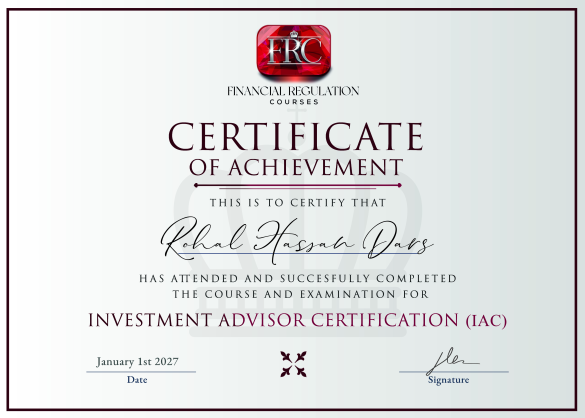
The Investment Advisor Certificate is relevant for investment analysts in Germany given the country's role as a hub for clients across Europe and beyond. Analysts at German-based firms regularly work with clients subject to multiple regulatory regimes across the EU and internationally.
The certificate's fourteen jurisdictional extensions — covering Germany, the UK, USA, UAE, Qatar, Saudi Arabia, Singapore, Hong Kong, Switzerland, India, Pakistan, Canada, Australia, and Europe — allow analysts to develop structured regulatory knowledge of the markets their clients are based in. For analysts at German asset managers and private banks serving institutional and private clients across European and global markets, this jurisdictional breadth is a practical professional advantage. The Investment Advisor Certificate sits alongside CFA or CIIA study rather than competing with either, addressing the client-facing regulatory dimension that the analytical qualifications do not cover.
For analysts working within German institutions with ESG mandates — Germany has been among the most proactive European markets in adopting sustainable finance principles, and the EU Sustainable Finance Disclosure Regulation applies directly to German fund managers — the ESG Advisor Certificate provides formal and recognised expertise in ESG analysis and portfolio integration. Germany's financial regulator BaFin has published guidance on sustainable finance, and the German sustainable finance market is one of the most developed in Europe. The ESG Advisor Certificate is available with the same fourteen jurisdictional extensions as the Investment Advisor Certificate.
The DVFA also offers specialist programmes in ESG analysis, fixed income, and derivatives that are relevant for analysts developing specific technical expertise within the German market.
Skills
Financial modelling and security valuation are the technical core of the investment analyst role in Germany as in other major markets. Proficiency in Excel, Bloomberg, and financial modelling across DCF, comparable company analysis, and sum-of-the-parts valuation is expected.
Understanding German GAAP — HGB — and IFRS, and the differences between them as applied to German-listed companies, is important for analysts covering German equities. Many German mid-market companies continue to report under HGB rather than IFRS, and analysts covering the full spectrum of German-listed companies need familiarity with both frameworks.
German language proficiency is a practical professional requirement for analysts working with German corporate managements, reading German-language company filings and press releases, and engaging with domestic institutional clients. At the major international financial institutions in Frankfurt, English is the primary working language, but German language capability is a meaningful differentiator for analysts covering German domestic companies and for those targeting roles at German-headquartered asset managers and banks.
Understanding of the German corporate landscape — including the Mittelstand, the network of highly successful mid-sized companies that form the backbone of the German economy, the co-determination structure of German corporations in which employee representatives sit on supervisory boards, and the cross-shareholding structures that have historically characterised large German corporations — is a genuine differentiator for analysts covering German equities in depth.
Experience
Graduate programmes and internships at German financial institutions are the primary structured entry route. Deutsche Bank, DWS, Allianz Global Investors, Union Investment, DekaBank, and the German operations of major international asset managers and investment banks all run graduate and internship programmes. The Pflichtpraktikum — mandatory internship — that is a standard requirement of German university programmes means that German graduates typically enter the job market with more structured work experience than their counterparts in some other countries.
German employers in investment management place significant emphasis on academic performance — the German Numerus Clausus grading system means that academic grades are directly comparable across candidates — and on evidence of genuine analytical interest and preparation through internships, CFA candidacy, and market engagement.
The sell-side research divisions of Deutsche Bank, Berenberg, Baader Bank, and the Frankfurt offices of major international investment banks provide sell-side analyst roles covering German and European equities, and the sell-side to buy-side transition is a well-established career pathway in the German market.
The Employer Landscape
Frankfurt is the primary centre of the German investment management industry and home to the headquarters of Deutsche Bank, DWS Group — one of Europe's largest asset managers — Commerzbank, and the Frankfurt operations of major international firms. DWS, Allianz Global Investors, Union Investment, DekaBank, and MEAG — the asset manager of Munich Re and ERGO — are among the largest German-headquartered asset managers.
Munich is home to Allianz, Munich Re, and their respective asset management subsidiaries, and has a significant financial services employment base. Hamburg, Düsseldorf, and Stuttgart have smaller but established investment management presences.
The German insurance sector — one of the largest in Europe — manages significant assets internally and employs investment professionals across asset allocation, fixed income, and alternative investment roles. Allianz Investment Management and MEAG are among the largest insurance-owned asset managers in Europe.
Salaries
Graduate investment analysts in Germany typically earn between EUR 50,000 and EUR 70,000. With two to four years of experience, salaries move to between EUR 70,000 and EUR 110,000. Senior analysts earn between EUR 100,000 and EUR 160,000. Portfolio managers at established German institutions earn between EUR 150,000 and EUR 300,000 including bonuses, with significant variation by firm type and asset class. Senior portfolio managers and CIOs at larger firms earn above these figures.
Germany's income tax rates are relatively high by international standards — the top marginal rate is forty-five percent plus solidarity surcharge — which means that net take-home pay is materially lower than in Singapore or Hong Kong at equivalent gross salary levels.
Career Progression
The standard progression runs from graduate analyst through analyst, senior analyst, and portfolio manager. The CFA designation and DVFA membership are the most important professional milestones in the German market. Developing German corporate sector knowledge,
European equity and credit expertise, and language capability in German alongside English are the practical priorities that shape long-term career trajectories. Building a professional network through the CFA Society Germany, the DVFA, and the broader Frankfurt and German financial services community is worth prioritising consistently.